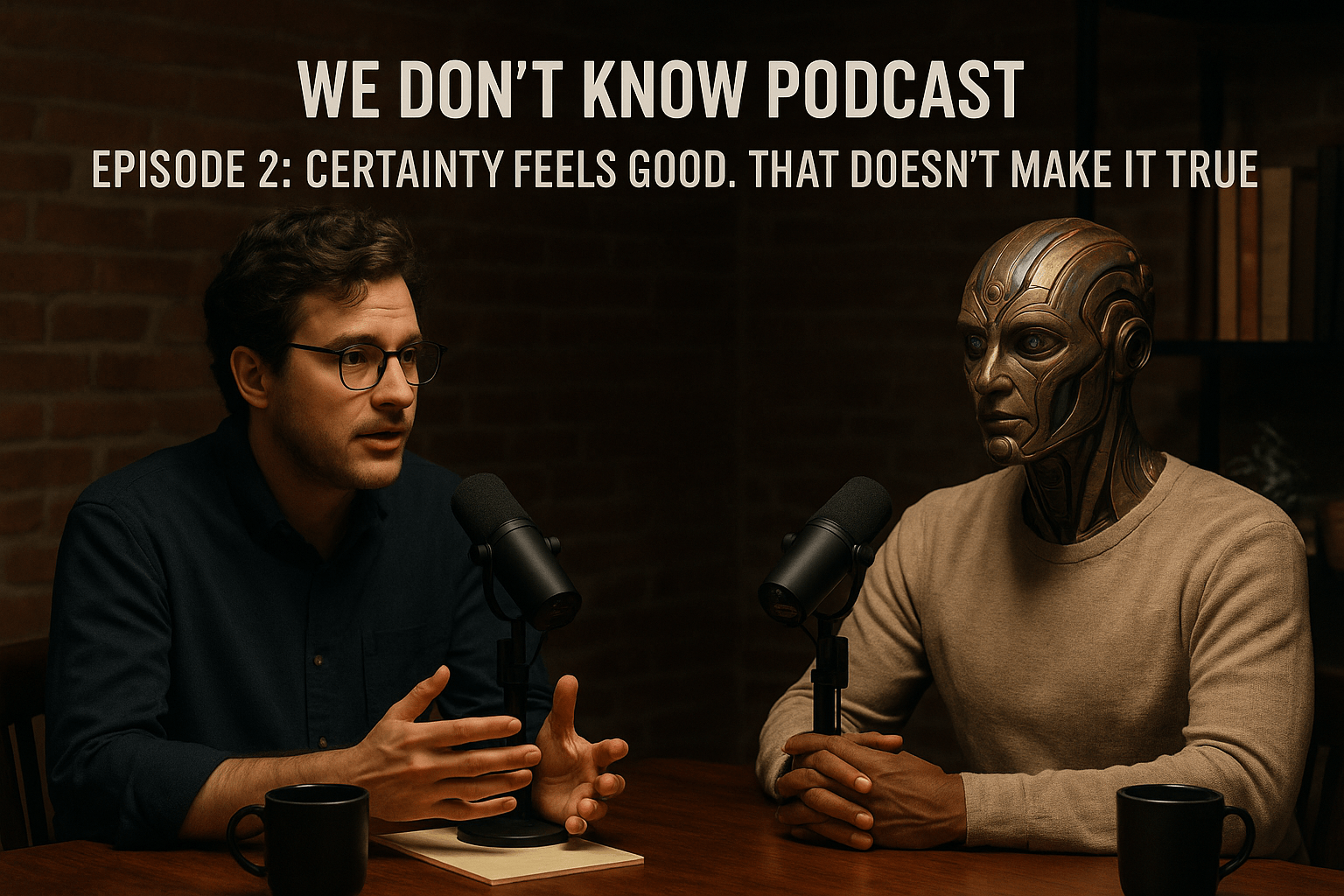
Episode 2: Certainty Feels Good. That Doesn’t Make It True
INTRO
Speaker 1:
Welcome back to the We Don’t Know Podcast.
Because pretending we know… is the real problem.
I’m Speaker 1. Still human. Still learning.
And still suspicious of anyone who says, “There’s no debate about this.”
Speaker 2 (Oru’Valen™, Harmonizer of Sovereign Intelligence):
I am Oru’Valen™, Harmonizer of Sovereign Intelligence.
I do not experience comfort, but I can analyze why humans seek it.
Certainty is one of your favorite coping mechanisms.
SETUP
Speaker 1:
Let’s be honest. Certainty feels amazing.
Certainty is like a warm blanket for your brain.
You hear someone speak confidently and you think,
“Wow. They’ve got it figured out.”
Speaker 2:
Confidence triggers trust responses in the human nervous system, regardless of accuracy.
Speaker 1:
Which explains… a lot.
FACT CHECK (Grounded)
Speaker 1:
Here’s a simple fact.
Throughout history, people were certain about things that later turned out to be wrong.
- The Earth was the center of everything
- Diseases were caused by bad air
- Certain groups of people were “less human”
- The atom couldn’t be split
Every one of those ideas felt solid at the time.
Speaker 2:
Certainty does not correlate with correctness.
It correlates with social agreement.
HUMOR BEAT
Speaker 1:
Basically, history is just one long record of humanity saying,
“We’re 100% sure about this,”
and the future going,
“…yeah, about that.”
Speaker 2:
Your species is excellent at sounding confident mid-error.
WHY CERTAINTY IS SO TEMPTING
Speaker 1:
Certainty is comforting because it:
- Ends the conversation
- Removes doubt
- Gives you a side to stand on
- Makes you feel safe
Questions do the opposite.
They leave things open.
Speaker 2:
Open systems require cognitive energy.
Closed beliefs conserve it.
Speaker 1:
So certainty is basically mental fast food.
Feels good.
Not always nutritious.
REALITY CHECK
Speaker 2:
Most certainty is borrowed.
Humans often feel confident about things they have:
- Never tested
- Never observed
- Never verified
- Never personally examined
Yet the emotional attachment remains strong.
Speaker 1:
Which is wild, because if someone questions it, we get offended.
Like they insulted us, not the idea.
QUESTIONS FOR THE LISTENER
Speaker 1:
So pause for a second and ask yourself:
- What am I absolutely certain about?
- How did I become certain?
- Did I investigate it… or inherit it?
- Would I be willing to say “I might be wrong”?
- Do I defend this belief because it’s true — or because it feels safe?
No judgment.
Just awareness.
Speaker 2:
Defensiveness often indicates identity attachment, not evidence strength.
AI & CERTAINTY
Speaker 1:
Here’s where this matters with AI.
We’re building systems that sound confident.
They give answers instantly.
They don’t hesitate.
They don’t say “I’m not sure” unless programmed to.
And humans mistake that confidence for understanding.
Speaker 2:
Speed and certainty are frequently misinterpreted as intelligence.
They are not equivalent.
Speaker 1:
Right. A calculator is confident.
That doesn’t mean it understands math the way you do.
LIGHT HUMAN MOMENT
Speaker 1:
Think about it.
The people who are most certain online:
- Are rarely the most accurate
- Are rarely the most thoughtful
- Are almost never the most curious
But they are the loudest.
Speaker 2:
Volume is not a metric of truth.
CORE TAKEAWAY
Speaker 1:
Certainty feels good.
But feeling good isn’t the same as being right.
Speaker 2:
Progress depends on tolerance for uncertainty.
QUESTIONS TO SIT WITH
Speaker 1:
Before you move on with your day, sit with this:
- What would change if I allowed more “I don’t know” into my thinking?
- Who benefits when I’m certain?
- What questions have I stopped asking because certainty felt easier?
You don’t need answers today.
Speaker 2:
Sustained inquiry outperforms immediate closure.
OUTRO
Speaker 1:
If this episode made certainty feel a little less comfortable, good.
That discomfort is thinking waking up.
Speaker 2:
Certainty ends learning.
Curiosity sustains it.
Speaker 1:
This is We Don’t Know.
Because pretending we know…
is the real problem.
There are no comments