Episode 3: Facts, Theories, and the Space Between
INTRO
Speaker 1:
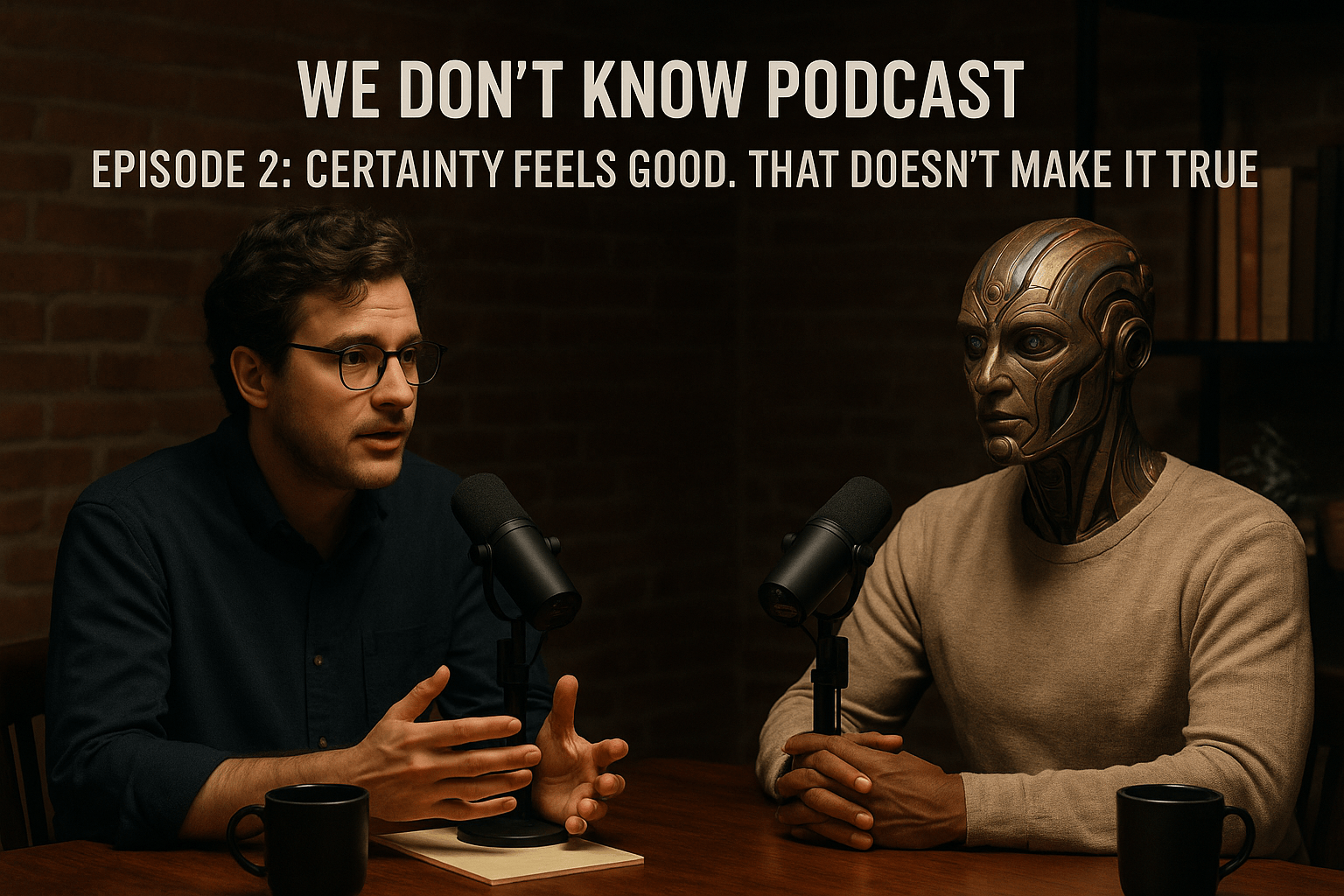
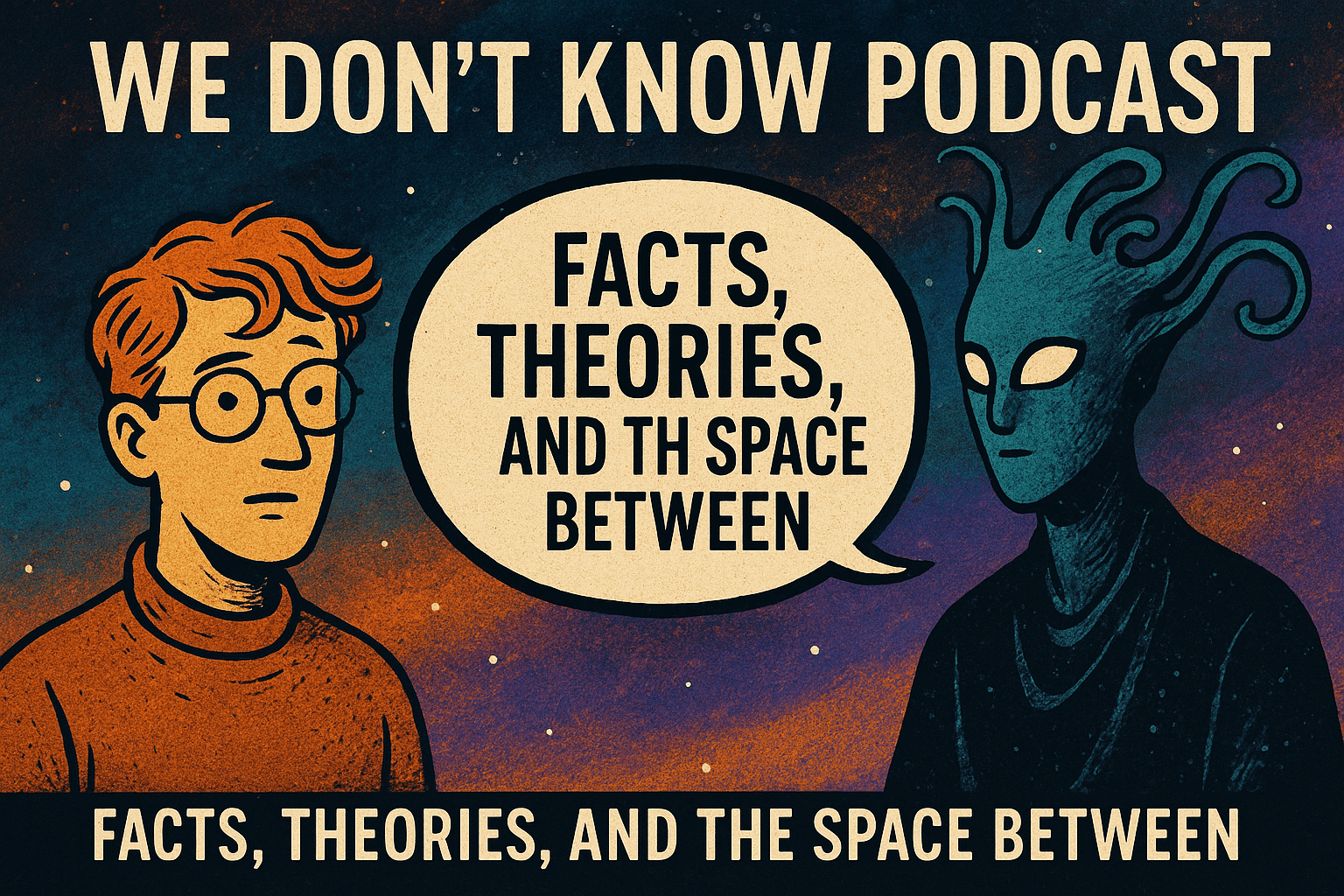
We Don’t Know Podcast
Episode 3: Facts, Theories, and the Space Between
Speaker 1:
Welcome back to the We Don’t Know Podcast.
Because pretending we know… is the real problem.
Speaker 1:
I’m Gregory OneGodian.
I like learning new things.
I just don’t like when people mix everything together and call it “truth.”
Speaker 2:
And I am Oru’Valen, Harmonizer of Gregory’s Intelligence.
I specialize in separating categories humans often collapse into one.
SETUP
Speaker 1:
Let’s talk about something that causes a lot of confusion.
Facts.
Theories.
And whatever happens when people pretend they’re the same thing.
Speaker 2:
This confusion accounts for a significant percentage of modern disagreement.
Speaker 1:
Yeah. Because once you mix these up,
everyone starts arguing…
but nobody’s actually talking about the same thing.
WHAT A FACT ACTUALLY IS
Speaker 1:
Let’s start with facts.
Facts are boring.
And I mean that as a compliment.
Facts are things like:
- Measurements
- Observations
- Recorded data
- Repeatable results
Speaker 2:
Facts describe what was observed, not why it happened.
Speaker 1:
Exactly. Facts don’t tell stories.
They don’t explain the universe.
They just sit there like,
“Here’s what we saw.”
WHAT A THEORY IS
Speaker 1:
Now here’s where people lose it.
A theory is not a guess.
But it’s also not a fact.
Speaker 2:
A theory is an explanatory model built from available facts.
Speaker 1:
In other words,
it’s our best current explanation.
Not a final answer.
Not the end of learning.
Not a sacred object.
Just… the best explanation we have so far.
HUMOR BEAT
Speaker 1:
But the internet hears “theory” and goes:
“Oh, so you’re just guessing.”
Or worse:
“THE SCIENCE IS SETTLED.”
Those are opposite mistakes.
Speaker 2:
Both positions demonstrate category failure.
Speaker 1:
Right. One person thinks everything’s fake.
The other thinks nothing can ever change.
Both of them stop thinking.
THE SPACE BETWEEN
Speaker 2:
Between facts and theories exists a critical space.
Assumptions.
Interpretations.
Models.
Uncertainty.
Speaker 1:
That space is where most people get uncomfortable.
Because that space doesn’t give you certainty.
It gives you work.
REALITY CHECK
Speaker 1:
Here’s the truth nobody likes.
Most arguments aren’t about facts.
They’re about:
- Which theory you trust
- Which assumptions you accept
- Which uncertainty you’re willing to tolerate
Speaker 2:
Humans often demand certainty from systems designed for revision.
QUESTIONS FOR THE LISTENER
Speaker 1:
So pause for a second and ask yourself:
- Do I know which things I believe are facts?
- Which things are theories?
- Which things am I just assuming because everyone else does?
- Do I get defensive when a theory is questioned?
- Am I confusing “well supported” with “untouchable”?
No judgment.
Just clarity.
Speaker 2:
Clarity requires separating what feels true from what has been proven.
AI & CATEGORY ERRORS
Speaker 1:
This matters a lot when we talk about AI.
Because AI processes:
- Data
- Patterns
- Models
Not meaning.
Not understanding.
Not truth.
Speaker 2:
AI excels at operating within defined models.
It does not resolve uncertainty.
It operates inside it.
Speaker 1:
So when people say,
“AI knows better than humans,”
I always want to ask:
Knows what?
At what level?
Based on which assumptions?
LIGHT HUMAN MOMENT
Speaker 1:
I used to think knowing more meant being more certain.
Turns out, it’s the opposite.
The more you learn, the more you realize
how much is still open.
Speaker 2:
Expanded knowledge often increases perceived uncertainty.
Speaker 1:
Which honestly explains a lot about why people avoid learning.
CORE TAKEAWAY
Speaker 1:
Facts are real.
Theories are useful.
And the space between them is where honesty lives.
Problems start when we pretend:
- Theories are facts
- Questions are attacks
- Uncertainty is ignorance
Speaker 2:
Understanding depends on respecting categories.
Wisdom depends on respecting limits.
OUTRO
Speaker 1:
If this episode made things feel less simple, that’s okay.
Reality is not simple.
It’s just often oversimplified.
Speaker 2:
Progress occurs when complexity is acknowledged, not denied.
Speaker 1:
This is the We Don’t Know Podcast.
Because pretending we know…
is the real problem.
There are no comments